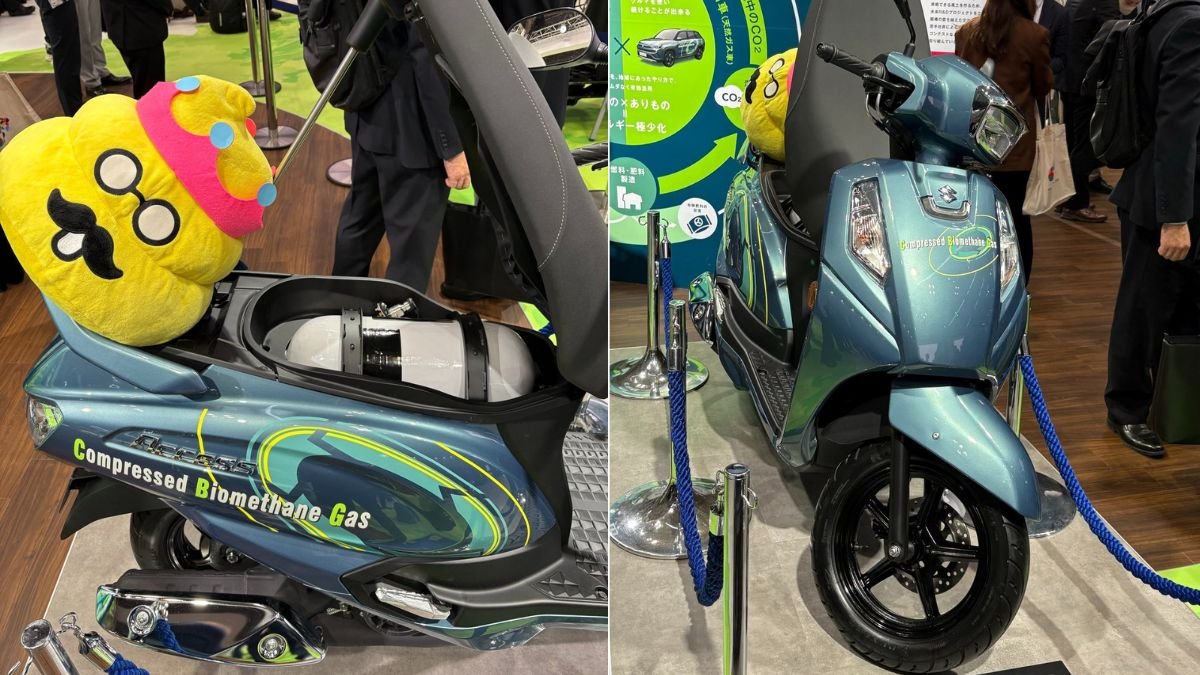

The whispers started in auto circles a few months ago, but now the chatter is loud enough to hear across India’s commuter belt: Suzuki is gearing up for something unusual, something very un-Japanese in boldness, a dual-fuel Access scooter that can run on both CNG and CBG. And if the early numbers floating around dealer networks hold up, this thing might rewrite the idea of affordability on two wheels.
Suzuki Access Dual-Fuel Technology
Dual-fuel technology isn’t exactly dinner-table talk in India, mostly because it’s been restricted to commercial vehicles and a handful of retrofitted bikes in small-town workshops. But Suzuki appears ready to put factory-grade engineering behind a concept nobody expected in the scooter segment.
The Access CNG/CBG, built on the familiar 125cc platform, reportedly gets a tweaked fuel-injection system, slightly altered combustion mapping, and a reinforced head to handle gaseous fuel pressures. Riders would be able to switch between CNG and CBG without stalling, coughing, or those awkward few seconds of the engine “figuring things out.”
Here’s the early tech picture:
| Feature | Expected Details |
|---|---|
| Fuel Type | CNG + CBG |
| Switching | Manual or ECU-assisted toggle |
| Engine Tune | Reworked FI + adjusted ignition timing |
| Emissions | Lower than petrol 125cc engines |
| Ride Feel | Expected to be similar to the petrol Access |
If Suzuki pulls this off at scale, this becomes more than just a new variant—it becomes a precedent.
Suzuki Access Eco-Friendly Ride
This isn’t Suzuki’s first dance with efficiency. The Access 125 built its reputation on being the reliable, smooth, dead-simple scooter you could run for years without drama. The challenge now is to keep that famously quiet, vibration-free nature while burning cleaner fuel.

CNG engines usually suffer from flat low-end torque or cold-start irritations. But supplier sources and early test impressions suggest Suzuki has re-tuned ignition sequencing to ensure riders don’t feel a sluggish “CNG lag” when pulling away from a light. The real test, as always, will be in bumper-to-bumper traffic—where scooters earn their keep.
On the environmental side, CNG and CBG promise significantly lower carbon monoxide, nitrogen oxide, and particulate emissions. With Indian cities consistently battling poor AQI readings every winter, even a small shift toward low-emission two-wheelers can have a real cumulative impact.
And since CBG comes from organic waste, the scooter indirectly supports India’s slow-but-steady push toward circular energy systems. Not bad for a machine that spends most of its life tottering through chowks and market lanes.
Suzuki Access Mileage & Running Cost
Let’s get to the part where most buyers will perk up: mileage.
Industry estimates suggest the Access CNG/CBG could deliver up to 100 km per kg. Even conservative estimates put it well above 80 km per kg, which would still make it one of the cheapest forms of motorized commuting in India.

A simple comparison paints the picture:
| Fuel Type | Approx Cost per Unit (2025)* | Estimated Mileage | Cost per km |
|---|---|---|---|
| Petrol | ₹108/litre | ~50 km/l | ~₹2.16/km |
| CNG | ₹80/kg | ~90–100 km/kg | ~₹0.80/km |
| CBG | ₹75–85/kg | ~90–100 km/kg | ~₹0.75–₹0.95/km |
*Metro average prices; actual rates vary by city.
For someone riding roughly 35 km a day, that’s annual savings in the ballpark of ₹18,000 to ₹20,000, money that matters, especially for delivery riders or families juggling multiple daily commutes.
And with CNG access points spreading across tier-1 and tier-2 cities, refueling isn’t the battle it used to be a decade ago. CBG stations are fewer but slowly increasing under the government’s waste-to-energy incentives.
Suzuki Access Green Revolution
India’s mobility landscape is in this awkward middle stage—consumers want electric, but they’re anxious about range, charging, and battery costs. Petrol is expensive. Daily commuting distances are rising. And the middle class, forever the balancing act in national economics, needs something that simply works.

That’s where a dual-fuel scooter fits beautifully.
It doesn’t demand new habits. It cuts costs immediately. It lowers emissions without turning your life upside down. Delivery fleets could save lakhs per year. Families could slash fuel budgets. Urban riders could travel worry-free without charging stops or battery degradation concerns.
If Suzuki prices the Access CNG/CBG in the ₹90,000 to ₹1 lakh ex-showroom slot, it’ll hit the sweet spot for budget-conscious buyers, college commuters, and fleet operators.
The Suzuki Access CNG/CBG, if launched, won’t just be another variant in a crowded market. It could be a strategic bridge between India’s costly petrol dependence and its far-off EV future.
A scooter that runs 100 km on a kilo of fuel, emits fewer pollutants, cuts running costs nearly in half, and still retains the Access’s iconic refinement? That’s not just smart engineering—it’s a potential market shake-up.

The idea might’ve sounded wild a few years ago, but today, it feels like something India’s roads are ready for. And if Suzuki plays its cards right, this dual-fuel Access could quietly become the country’s next mileage legend.
Disclaimer: Most details are based on early leaks, supplier inputs, and prototype testing observations. Pricing, mileage figures, and features remain expected, not verified. Readers should treat this scooter as “upcoming/likely” rather than “officially announced.”
FAQs
Is the Suzuki Access CNG/CBG officially launched?
No. It’s expected, but Suzuki hasn’t made a formal announcement yet.
Will the CNG/CBG version be slower than the petrol Access?
Early indications suggest similar performance, but real-world feel will be clear only after launch.
Are CNG systems safe for two-wheelers?
Factory-fitted CNG systems follow strict testing norms. Safety should be comparable to CNG cars.
What kind of mileage can riders expect?
Industry estimates suggest up to 100 km per kg, though real conditions may vary.
Who is this scooter best suited for?
Daily commuters, delivery riders, and anyone looking for the lowest possible running cost.
