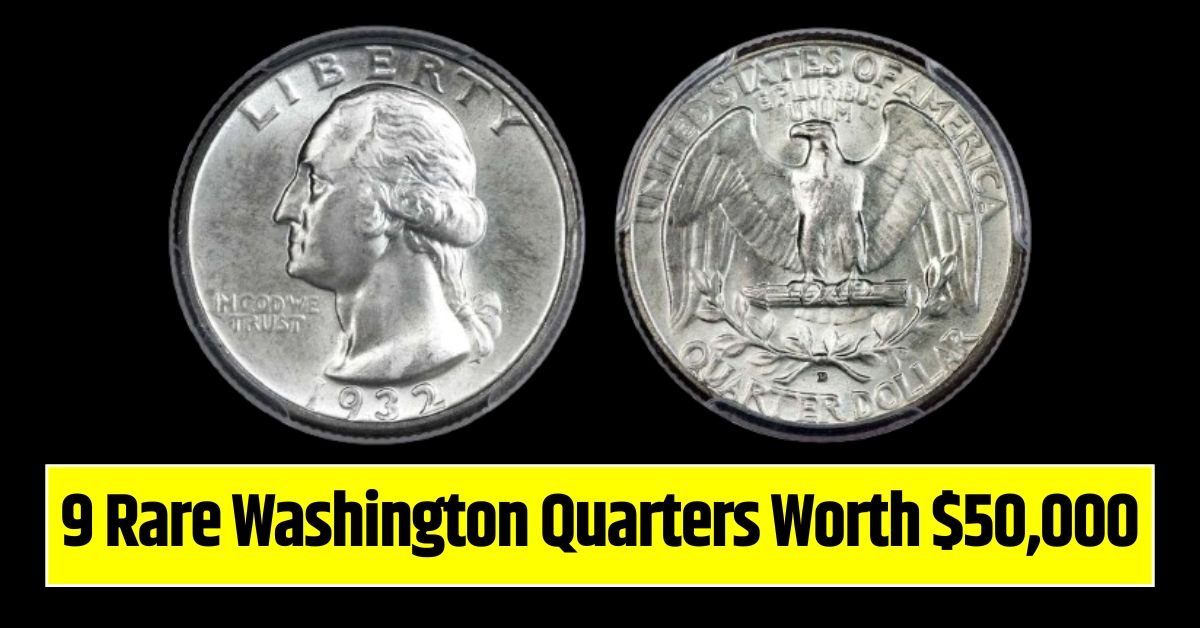

Most people toss quarters into a cup holder without a second thought. But for a few sharp-eyed collectors, that same 25-cent coin could be worth more than a year’s rent. The Washington Quarter, first struck in 1932 to honor America’s first president, has quietly become one of the most collectible U.S. coins ever made.
Over the decades, minting errors, metal transitions, and limited production runs have turned some of these coins into genuine rarities — hiding in plain sight inside old jars and forgotten drawers. Here are nine of the rarest and most valuable Washington Quarters ever minted, and the stories behind their sky-high price tags.
1. 1932-D Washington Quarter
The 1932-D is the undisputed legend of the series — the “holy grail” for quarter collectors. Only 436,800 were struck at the Denver Mint, the lowest mintage of any Washington Quarter.
Even coins that look like they’ve survived a few decades in a vending machine can bring $200–$500. Uncirculated examples? They can soar to $20,000–$40,000. Look just below the eagle’s tail feathers for the tiny “D” mint mark that sets it apart.
2. 1932-S Washington Quarter
If the Denver issue is famous, the 1932-S is its even scarcer twin. Only 408,000 coins came out of San Francisco that year — and collectors have been chasing them ever since.
In average circulated condition, prices hover between $150 and $500. Mint-state versions, though, have crossed $15,000 at major auctions. Again, check for the “S” mint mark under the eagle’s tail.
3. 1943 Doubled Die Obverse Quarter
Wartime minting produced plenty of quirks, and this one’s among the most dramatic. The 1943 Doubled Die Obverse shows clear doubling on “LIBERTY” and “IN GOD WE TRUST.” The effect came from a misaligned double strike during the die preparation process.

Collectors pay anywhere from $500 to $1,500, depending on how sharp and visible the doubling appears.
4. 1950-D/S Overmintmark Quarter
This coin’s story is pure minting drama. On some 1950 quarters, a Denver “D” mint mark was accidentally punched over a San Francisco “S.”
Under magnification, both letters are visible — a tiny alphabet soup beneath the eagle. That curiosity now trades for $400–$2,000, with pristine coins commanding even more from error specialists.
5. 1964-D Silver Quarter
This was the end of an era — the last Washington Quarter struck in 90% silver before the U.S. Mint switched to copper-nickel clad composition in 1965.
Silver’s intrinsic value gives these coins a solid base worth, with circulated examples going for $10–$50. Brilliant uncirculated pieces — those that never hit pockets — can top $1,000. Fun fact: silver quarters weigh 6.25 grams, versus 5.67 grams for modern ones.
6. 1970-S Proof Quarter Struck on a 1941 Canadian Coin
This one’s a jaw-dropper. During proof coin production in 1970, a few Washington Quarters were mistakenly struck over 1941 Canadian silver quarters, leaving ghostlike traces of both designs visible under magnification.

Only a handful are known to exist. One sold for over $35,000, making it one of the most valuable modern mint errors in U.S. history.
7. 1976 Bicentennial Quarter Double Die Error
The Bicentennial Quarter, with its drummer boy design, is already an American icon. But a few were struck with a double die error — visible doubling on “1776–1976” and “IN GOD WE TRUST.”
Depending on clarity and grade, these coins fetch $500–$1,500. Considering billions of normal Bicentennial quarters were minted, finding one with this error is like hitting the numismatic lottery.
8. 1999-P Connecticut Quarter Experimental Planchet
When the State Quarters program launched in 1999, the Mint ran tests on new metal planchets for the upcoming Sacagawea Dollar. A few of those experimental blanks ended up under the presses for Connecticut quarters, creating a stunning hybrid error.
These coins appear slightly golden and weigh less than a standard quarter. Verified examples have brought $10,000 or more at auction.
9. 2004-D Wisconsin Quarter with Extra Leaf
If you ever spot a 2004-D Wisconsin quarter, flip it over. Some show an extra “leaf” on the corn husk — one pointing high, another low. It’s a die flaw that became a modern legend.

These quirky variants now trade for $200–$1,500, depending on condition. Not bad for something still occasionally turning up in change.
How to Identify a Rare Washington Quarter
The key is in the details — and sometimes, a good magnifying glass.
- Mint Marks: On pre-1999 quarters, look under the eagle’s tail. On post-1999 designs, it appears beside Washington’s ponytail.
- Weight: Silver quarters (pre-1965) weigh 6.25g, while clad ones weigh 5.67g.
- Visual Errors: Watch for doubled lettering, color variations, or added design elements (like that Wisconsin leaf).
If something looks off — too heavy, too light, or too golden — don’t dismiss it. Have it authenticated by professional grading services like PCGS or NGC. A $0.25 curiosity could turn into a five-figure payday.
Why These Quarters Are So Valuable
Three forces drive value in coin collecting: rarity, condition, and demand. Silver issues attract investors hunting for precious metals, while error coins fascinate hobbyists chasing the “impossible find.”
As more high-grade examples disappear into private collections, prices rise. Even small design quirks — an extra leaf, a doubled date — can turn an ordinary coin into a jackpot.
Experts agree: the Washington Quarter remains a cornerstone of American numismatics. It’s part history, part art, and, occasionally, part miracle.

FAQs
What is the rarest Washington Quarter?
The 1932-D is widely considered the rarest and most valuable regular-issue Washington Quarter.
Are all 1964 quarters silver?
Yes. Every 1964 quarter was struck in 90% silver the final year before the Mint switched to clad metal.
How can I tell if my quarter is valuable?
Look for rare mint marks, doubling, unusual colors, or differences in weight.
What’s the most valuable modern Washington Quarter?
The 1970-S Proof Quarter struck over a 1941 Canadian coin — one sold for over $35,000.
Should I clean my old quarters?
Never. Cleaning can destroy surface detail and slash value. Handle them gently and use gloves when possible.
