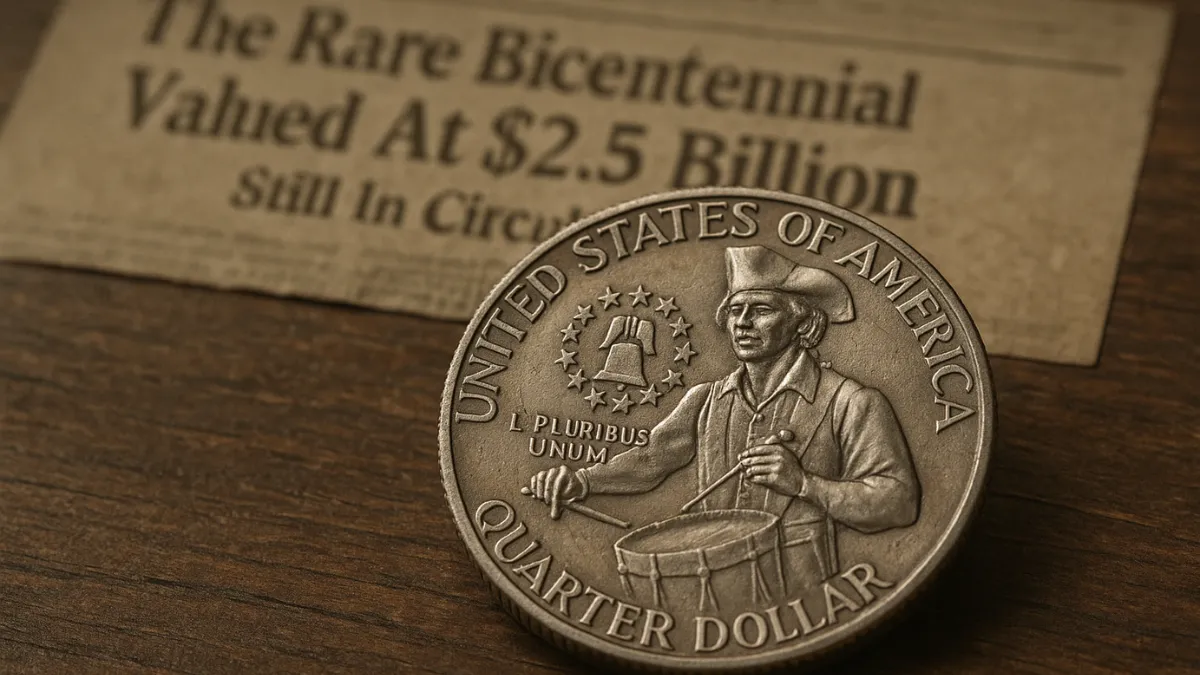

A quarter that could change your life. The idea sounds almost mischievous like something a late-night radio host would whisper about between static bursts. But stories like the “billion-dollar Bicentennial Quarter” survive because they feed a very old instinct: that something forgotten in a junk drawer might just hold a secret. And while no circulating U.S. quarter has ever sniffed a billion-dollar valuation, the romance of the hunt hasn’t gone anywhere. If anything, it’s grown louder as collectors, casual hobbyists, and curious savers take a second look at the drummer boy design minted nearly fifty years ago.
A Coin Minted for a National Party
Back in 1976, the U.S. Mint rolled out an unusual project—three circulating denominations (quarter, half dollar, dollar) carrying special designs for America’s 200th birthday. The quarter, of course, stole the show. The eagle vanished from the reverse, replaced by a colonial-era drummer and a flintlock rifle, framed by thirteen stars.
The U.S. Mint’s own documentation on the commemorative program—still posted at catalog.usmint.gov—shows just how huge the mintage was. We’re talking more than 1.6 billion Bicentennial quarters struck at Philadelphia and Denver combined, plus additional 40% silver collector editions from San Francisco.
Here’s how those numbers break down:
Bicentennial Quarter Production
| Mint | Type | Approx. Mintage |
|---|---|---|
| Philadelphia | Circulation strike | ~809 million |
| Denver | Circulation strike | ~860 million |
| San Francisco | 40% silver uncirculated | ~11 million |
| San Francisco | 40% silver proof | ~4 million |
| San Francisco | Clad proof | ~7 million |
When you see figures like that, the math gets obvious: nearly all drummer boy quarters today trade hands for twenty-five cents. But “nearly all” leaves the door cracked open just enough for the legends to wander in.
Where Rare Value Actually Comes From
The numismatic world isn’t fueled by fantasy—it’s fueled by anomalies. The U.S. Mint documents error types extensively in its production guidelines posted at usmint.gov and the National Institute of Standards and Technology (NIST) explains why even tiny variations can emerge during large-scale production.

Collectors chase the breaks in the pattern:
The coin struck on the wrong metal.
The one hit by the dies twice.
The one with a missing layer, a tilted strike, or an overstressed die.
These mistakes don’t happen often, but when they do, they can elevate a coin’s value dramatically. A dramatic off-metal strike—say, a quarter accidentally punched onto a 40% silver blank meant for collector sets—could fetch five figures, sometimes more, depending on condition and certification. The key is authentication. Without a grading service such as PCGS or NGC, even a spectacular error becomes just a curious conversation piece.
Why This Story Refuses to Fade
A funny thing happens with nostalgic coins: they create folklore. The Bicentennial Quarter came out during a feverish patriotic moment, and millions of kids pocketed them as keepsakes. For decades afterward, they sat in shoeboxes, tool drawers, and cookie tins.
So whenever someone online claims there’s a lost, mind-bendingly valuable Bicentennial specimen floating in circulation, people lean in. Because maybe—just maybe—it’s sitting in that old Folgers can in the garage.

And let’s face it: treasure-hunt economics never really goes out of style.
Spotting a Bicentennial Quarter Worth More Than Face Value
If you’re tempted to sift through your stash, your car cup holder, or the pile of laundry-day coins on top of the dryer, here’s what separates the everyday from the interesting.
Key Features to Check
- Major Doubled Die Errors
Look for clear doubling on “LIBERTY,” “IN GOD WE TRUST,” or the drummer’s details. True doubled dies are rare and easily misidentified—magnification helps. - Off-Center or Broadstruck Coins
If part of the design is missing or dramatically shifted, value rises sharply. - Silver Appearance
San Francisco minted 40% silver Bicentennial quarters for collectors. These were never intended for circulation, but a few have slipped out over the years. A quick weight test (silver versions weigh 5.75g vs. 5.67g for clad) or comparison to the specifications listed at govinfo.gov can confirm composition. - Uncirculated or Prooflike Condition
A fresh, lustrous quarter with zero circulation wear can be worth a few dollars—sometimes more if it grades exceptionally high.
Quick Reference Table
| Feature | Approx. Value |
|---|---|
| Circulated common coin | $0.25 |
| Standard uncirculated | $1–$5 |
| 40% silver proof | $8–$15+ |
| Major off-center strike | $200–$1,000 |
| Confirmed off-metal error | $5,000–$20,000+ |
| High-grade, certified MS-67+ | Can exceed $1,000 |
No billion-dollar rarities. But certainly enough to make a Tuesday afternoon a little more interesting.
The Real Legacy of the Drummer Boy Quarter
Ask any long-time collector and they’ll tell you the value of the Bicentennial Quarter isn’t just monetary. It’s historical, almost sentimental. These coins sit at the intersection of everyday life and national celebration. They’re small, democratic pieces of Americana—everybody got one, everybody remembers them, and yet only a few will ever be truly collectible.

And maybe that’s the charm. The thrill isn’t in getting rich; it’s in spotting something special that everyone else overlooked.
Because the internet is awash in sensational claims about “billion-dollar Bicentennial quarters,” here’s what’s real:
- No U.S. quarter has ever sold for a billion or even a million—dollars.
Official auction records from PCGS and Heritage Auctions confirm this. - There are valuable Bicentennial Quarters, especially authenticated errors and high-grade silver issues, but they top out in the low five-figure range.
- The U.S. Mint confirms no rare ultra-limited Bicentennial varieties were ever intentionally released.
When in doubt, professional grading remains the gold standard.
FAQs
What makes the Bicentennial Quarter special?
Its one-year commemorative design celebrating America’s 200th birthday and its enormous presence in 1970s circulation.

Are any Bicentennial Quarters rare?
Yes, 40% silver versions, high-grade proofs, and authenticated mint errors can carry strong collector value.
How can I tell if my quarter is valuable?
Look for clear errors, pristine surfaces, or silver composition. If something seems off, get it evaluated by PCGS or NGC.
Can these still show up in circulation?
Absolutely. Silver issues are unlikely but not impossible; error strikes do occasionally surface decades later.
Where can I learn more?
The U.S. Mint, PCGS CoinFacts, local coin clubs, and numismatic reference guides offer reliable information.
